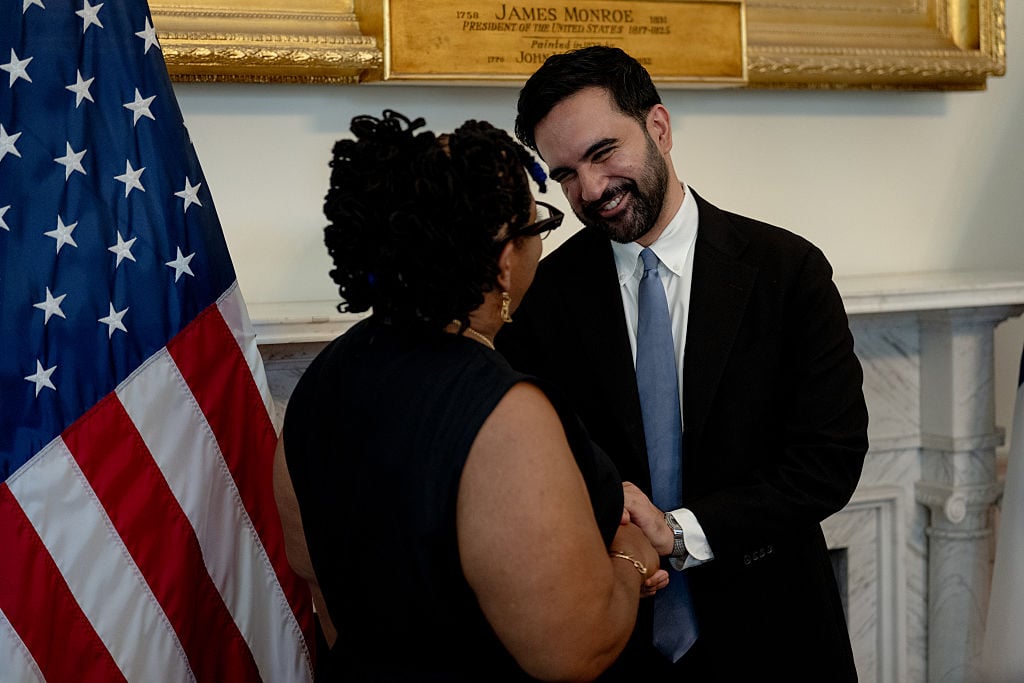
The Democratic Party is wrestling with who gets to define its future after several candidates backed by Zohran Mamdani and the Democratic Socialists of America (DSA) won recent Democratic primaries in New York.
The victories have quickly exposed competing visions for the party. Some Democratic leaders see them as a warning against moving too far left, while others argue they reflect voters’ demand for a clearer message, younger leadership and candidates willing to challenge the political establishment.
But while the debate has centered on Mamdani, political scientists say it’s really about whether Democrats are correctly interpreting what voters are asking for. Interviews with Blavity suggest the conversation extends beyond one politician’s influence to questions about the party’s message, coalition and strategy as Democrats look to rebuild momentum ahead of the midterms and the 2028 presidential election.
The proxy for the party’s future
Mamdani’s political influence has quickly grown since his upset victory in New York City’s 2025 mayoral race. And last month, his endorsement of several successful primary candidates intensified speculation about whether his coalition could become a model for Democrats across the country.
The Washington Post recently reported that left-wing challengers are defeating establishment-backed Democrats in primary elections, while CNN noted that the election results have highlighted disagreements over whether contested primaries strengthen the party by bringing in new voices or weaken it by unseating incumbents.
Former Democratic National Committee Chair Jaime Harrison has urged Democrats to focus on defeating Republicans instead of celebrating primary losses by fellow Democrats and received pushback for it. Progressives have countered that competitive primaries are exactly how voters shape the direction of a political party.
More than an ideological shift
For Chryl Laird, associate professor of government and politics at the University of Maryland, College Park, Mamdani’s rise reflects frustrations that have endured inside the Democratic Party rather than a sudden embrace of democratic socialism.
Laird said Democrats have often struggled to connect their policy accomplishments to voters’ everyday concerns, while Democratic Socialists have been far more successful at communicating what they stand for.
“You can disagree with the policies all day long if you want to,” Laird said. “But I know exactly what they stand for.”
She sees the moment as part of a deeper generational shift, with younger Democrats seeking candidates who offer a more direct vision for addressing economic challenges. Rather than resisting Mamdani’s success, she argued, Democrats should study why his message is resonating.
“The Democratic Party should learn from that,” Laird said. “Instead of being resistant to it. They should recognize it. They should learn from it, and they should start to adapt.”
Looking beyond New York’s results
Andra Gillespie, an associate professor in the Department of Political Science at Emory University who studies Black political behavior and elections, cautioned against viewing New York’s results as evidence that Democratic voters have widely embraced Democratic Socialists.
She noted that Black voters initially favored former New York Gov. Andrew Cuomo over Mamdani during the Democratic mayoral primary before many ultimately supported Mamdani in the general election, suggesting many voters were making pragmatic electoral decisions rather than uniformly backing one ideology. She also pointed to turnout, arguing that in low-turnout primaries, highly organized campaigns can have an outsized impact on election outcomes.
Instead, Gillespie said the recent elections point to something broader than ideology.
“I think there is a hunger for change,” she said, arguing that many voters are responding to candidates who project conviction and a willingness to fight for their priorities.
She cautioned, however, against treating New York as a national blueprint. Gillespie pointed to Colorado, where progressive candidate Melat Kiros unseated longtime Rep. Diana DeGette while progressive state Sen. Julie Gonzales lost decisively to incumbent Sen. John Hickenlooper in the Democratic Senate primary the same day. The split outcome, she said, suggests voters may be responding as much to individual candidates and local political dynamics as to any single political movement.
Why Democrats should zoom out
Whether Mamdani’s influence ultimately reshapes the Democratic Party has yet to be determined.
What is already clear is that his rise has become a catalyst for serious conversations about the party’s identity. Democrats aren’t just debating one mayor or one movement. They’re wrestling with whether voters want a more progressive agenda, a stronger message or simply candidates who project conviction and a willingness to fight.
The answer may determine not only how Democrats respond to Mamdani’s success, but how they define the party’s future.
